We May Be Looking for the Skills Gap in the Wrong Place
Explore my NLP research and published research.
Studies and congressional reviews in the Philippines have pointed to a persistent concern: many K–12 Senior High School graduates enter tertiary education needing additional support in foundational knowledge and skills. As a result, universities often establish remedial, bridging, and intervention programs to help students catch up. These programs are important but they can only do so much.
By the time a student reaches higher education, years of learning habits, foundational knowledge, and academic gaps have already been formed. Bridging programs can address some of these gaps, but they are not a substitute for strengthening the foundation earlier in the educational journey.
This also helps explain why the conversation about the industry–academe skills gap often becomes a cycle:
- Industry identifies skills that graduates need.
- Higher education asks industry for data about those needs.
- Industry, understandably, is not always structured or resourced to conduct formal educational workforce studies.
- HEIs then make their best efforts to respond to available information, while employers continue to encounter graduates who may need additional training.
- And the cycle repeats.
The problem is not necessarily that industry is asking for too much or that HEIs are failing to teach what matters. The deeper problem may be that we are trying to solve a pipeline problem near the end of the pipeline.
We need to look much further upstream.
If foundational competencies in mathematics, science, technology, communication, digital literacy, and problem-solving are not adequately developed during basic education, neither HEIs nor industry can completely compensate for that later.
This becomes even more important in the age of Artificial Intelligence, where STEM foundations, computational thinking, digital literacy, adaptability, and the ability to learn continuously are becoming increasingly important—not only for future IT professionals, but across virtually every sector.
Perhaps the conversation should therefore move from:
"Why are HEI graduates not meeting industry expectations?"
to:
"How can the entire education-to-employment ecosystem work together so students develop the right foundations from the beginning?"
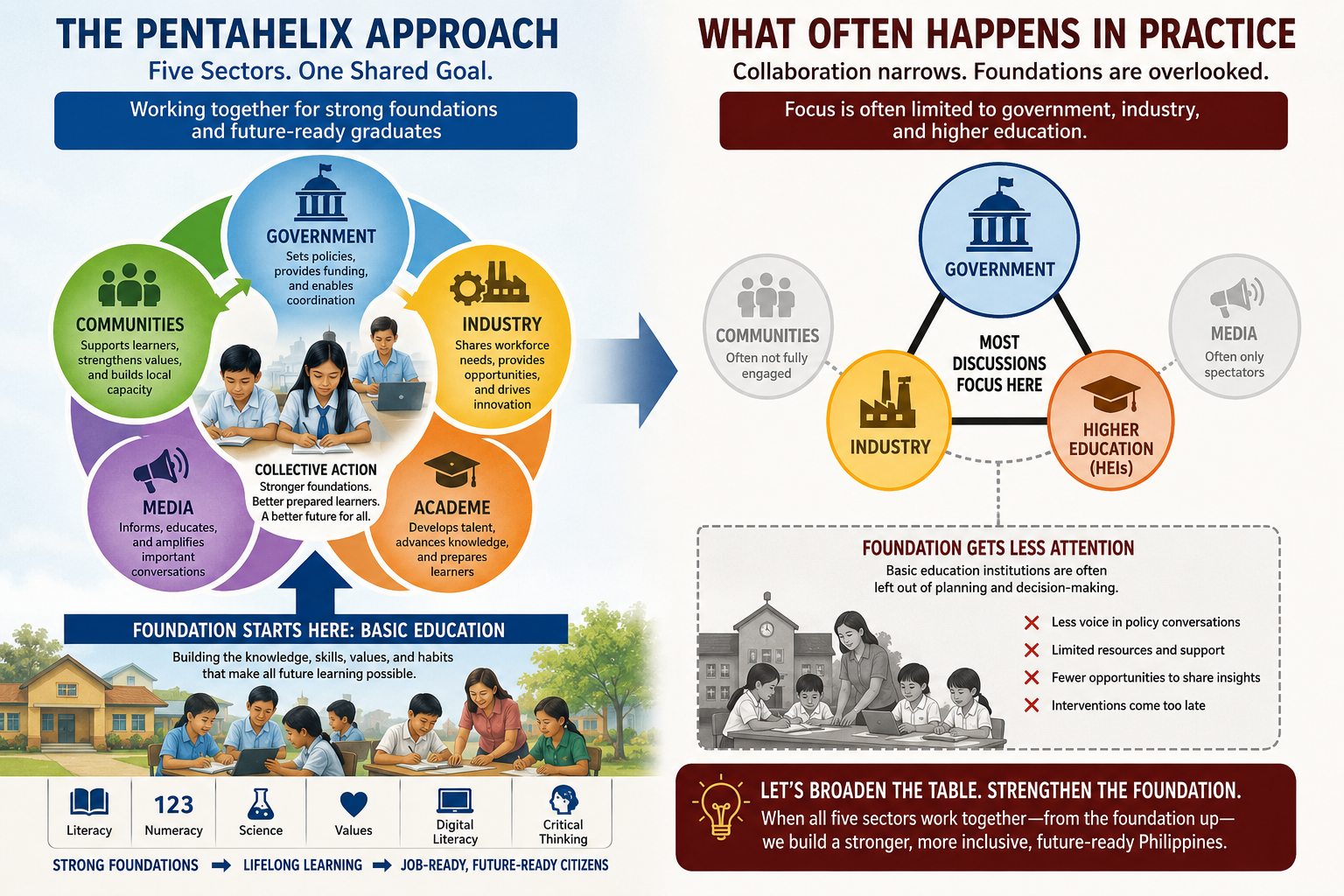
This is where the pentahelix approach becomes important:
Government, academe, industry, communities, and media all have roles to play. Yet in practice, collaboration often centers on government, business, and higher education. Even within "academe," discussions frequently focus on HEIs, while basic education institutions receive considerably less attention, even though they are the most crucial part of the system for developing foundational skills.
Communities and media can also play a much bigger role than simply observing the problem.
We need more conversations that cross these boundaries. More importantly, those conversations need to result in concrete, sustained interventions rather than just meetings, reports, and recommendations.
Starting Where the Foundation Is Built
This is one reason I built a small platform starting with Grade 7 students.
I created Grade 7 reviewers and learning resources that are freely accessible to students, parents, and teachers, aligned as much as possible with the Department of Education's curriculum.
The goal is simple: help students strengthen their foundations early, rather than waiting until they reach college before we discover the gaps.
The platform is currently available at:
https://grade7.copewithtech.com
I am making it available for free because I believe educational intervention should not always depend on a student's ability to pay for additional resources.
- For parents, it can provide another resource to help their children reinforce what they learn in school.
- For teachers, it can serve as supplementary material for review, reinforcement, or remedial activities, particularly when time and resources are limited.
- And for students, it is simply another opportunity to practice and learn.
However, I cannot build the entire pipeline alone.
I am looking for volunteers who can help review, improve, and expand the content, as well as developers and educators who are interested in helping make the project open source.
The long-term goal is to build resources covering Grade 7 through Grade 12.
I am also looking for sponsors and partners who can help the project grow into a dedicated, sustainable educational platform with its own website and infrastructure.
This isn't intended to replace what our schools are already doing.
It is intended to supplement the system and strengthen the foundation.
If we genuinely want to reduce the industry–academe skills gap, perhaps we should stop looking only at the point where graduates enter the workforce.
The solution may begin years earlier, when students are still building the foundations upon which their future education, careers, and ability to adapt to technologies like AI will depend.
If we want better graduates, we need to start by helping create better-prepared learners.
If you are interested, please send me an email at [email protected].
Related Articles
AI Just Designed 16 New Viruses. Should We Be Worried?
Scientists just used artificial intelligence to design 16 new viruses! These viruses do not exist in nature. The AI invented them from scratch. You can read the latest reports from …
Read More →Solving Code-Switching ASR for Davao and Beyond
Let's face it. Communication in the Philippines has stopped being a single-language thing. If you listen to a conversation in Davao City today, you'll rarely hear pure English, pure Tagalog, …
Read More →A Study Shows Schools Need Better AI Policies, Not Better AI Detectors (Here Are 5)
We talk a lot about human-centered AI in education today. We tell students to use AI responsibly and keep their critical thinking sharp. But here is the ironic reality on …
Read More →Subscribe to Updates
Get notified about new blog posts, AI insights, and digital transformation strategies.
We respect your privacy. Unsubscribe at any time.