Solving Code-Switching ASR for Davao and Beyond
Explore my NLP research and published research.
Let's face it. Communication in the Philippines has stopped being a single-language thing. If you listen to a conversation in Davao City today, you'll rarely hear pure English, pure Tagalog, or pure Cebuano.
Instead, we naturally blend all three into a fluid mix (often called Bislish or Davao Tagalog-Cebuano code-switching) within a single sentence. It flows effortlessly for locals. But for standard Automatic Speech Recognition (ASR) models, it completely breaks down.
The Problem with Off-the-Shelf Speech Recognition
Most global ASR models, including top-tier commercial platforms, are trained on monolingual datasets or distinct multi-language models that expect a speaker to pick one language and stick to it. When an AI hears a speaker jump from English technical terms to Cebuano conversational filler and Tagalog sentence structures, it panics. It either hallucinates words, misinterprets phonetic sounds, or drops context entirely.
This limitation isn't just a minor annoyance. It's a massive hurdle for local technological adoption. Because existing models struggle to transcribe our real-world daily speech, we're currently locked out of building reliable local AI solutions, such as:
- Automated meeting transcripts for local government, businesses, and university operations.
- Voice-enabled customer support and local business tools.
- Accessible digital tools for community health and public service dispatchers.
Building the Benchmark Leaderboard
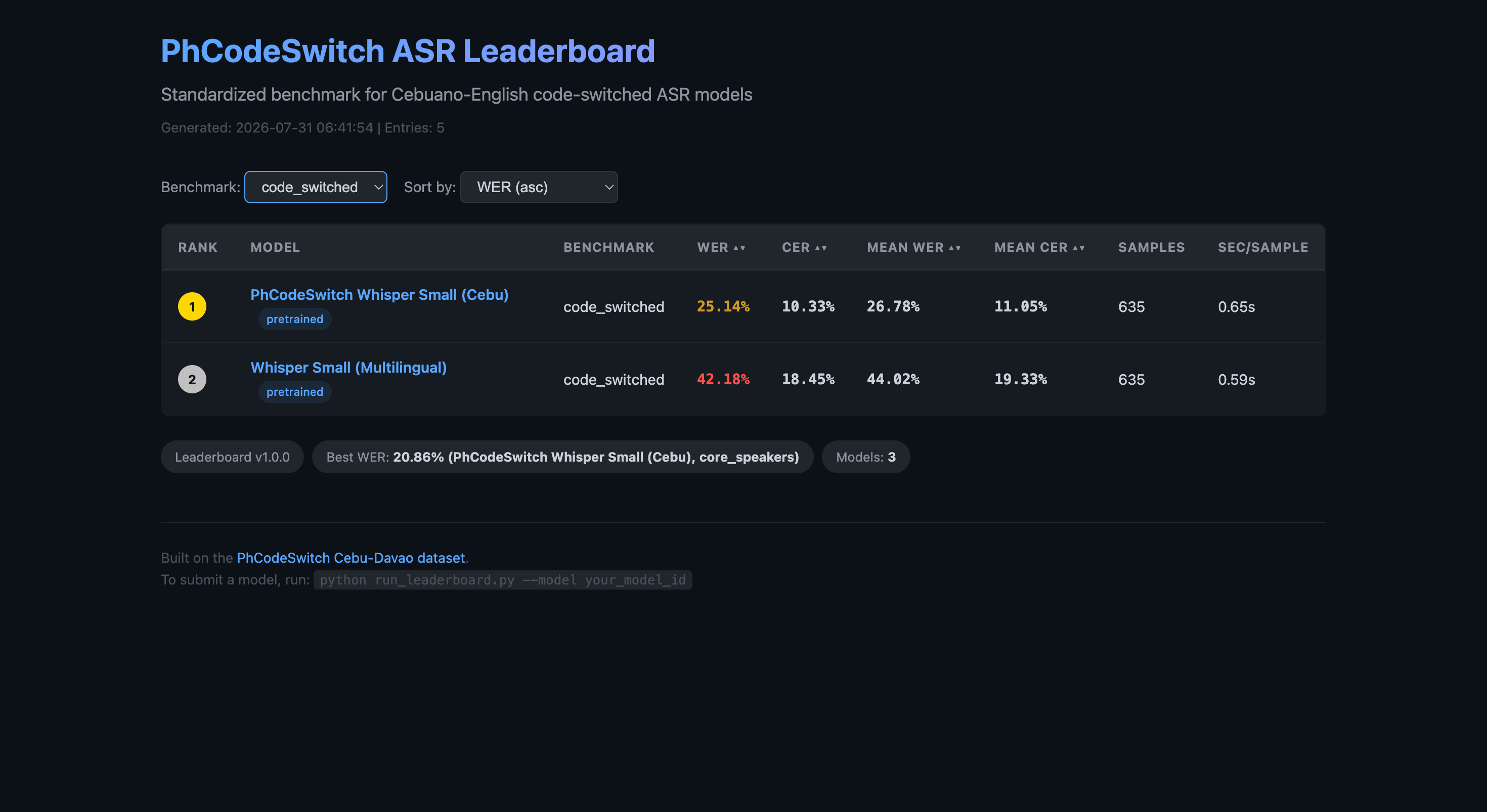
To help address this problem, I built a benchmark platform to measure, evaluate, and push forward ASR models tailored specifically for our local code-switching speech patterns.
Having a clear leaderboard provides developer teams and researchers with an objective baseline. Instead of guessing whether a model fine-tune works, we can benchmark exact Word Error Rates (WER) against actual Davao-centric code-switching speech datasets.
Here is where the project stands right now:
- Current Benchmark: The leaderboard currently evaluates fine-tuned OpenAI Whisper models against local code-switching patterns.
- Initial Model: I uploaded my first fine-tuned model on HuggingFace to seed community evaluation.
- The Ultimate Goal: Moving beyond simple fine-tuning toward building a model optimized for our local dialects and real-world use cases.
Model and Leaderboard Links
You can test the model, review the benchmark criteria, or contribute to the leaderboard using the resources below:
- Fine-Tuned ASR Model: eemberda/phcodeswitch-ceb-dvo on HuggingFace
- Benchmark Leaderboard: Philippine Code-Switching ASR Leaderboard

Let's Collaborate
Building speech recognition that truly understands how Filipinos communicate is too big of a challenge for one person working in isolation. It takes a community of AI developers, researchers, linguists, and engineers.
If you want to work together on dataset curation, model training, or testing practical deployment use cases in real-world organizations, let's connect. Let's build AI tools that actually speak our language.
Related Articles
We May Be Looking for the Skills Gap in the Wrong Place
Studies and congressional reviews in the Philippines have pointed to a persistent concern: many K–12 Senior High School graduates enter tertiary education needing additional support in foundational knowledge and skills. …
Read More →AI Just Designed 16 New Viruses. Should We Be Worried?
Scientists just used artificial intelligence to design 16 new viruses! These viruses do not exist in nature. The AI invented them from scratch. You can read the latest reports from …
Read More →A Study Shows Schools Need Better AI Policies, Not Better AI Detectors (Here Are 5)
We talk a lot about human-centered AI in education today. We tell students to use AI responsibly and keep their critical thinking sharp. But here is the ironic reality on …
Read More →Subscribe to Updates
Get notified about new blog posts, AI insights, and digital transformation strategies.
We respect your privacy. Unsubscribe at any time.