Stanford's 2026 AI Index Report: the Philippines is Out of the Picture
Explore my NLP research and published research.
I just finished reading the new 2026 AI Index Report from Stanford. It is a massive document, but it is the best way to see where the world is headed with this technology.
Well, here are the most important points for me.
- AI is not slowing down. Models are now passing PhD-level science exams. They are even winning medals in math competitions. This means that expert knowledge has become available to the public now more than ever. This offers a chance for developing countris (such as the Philippines) to really catch up (supposedly).
- The gap between the US and China is gone. They are basically tied for the best models now. China is leading in patents and robots. However, the US still spends way more money. What this means for us in the Philippines is that we don't need to rely on more expensive models from the Philippines. Chinese AI models are competing and it is more affordable for MSMEs.
- We are hitting a "jagged frontier" (that is what the researchers call it). An AI can solve a complex physics problem but still cannot read an analog clock correctly. It is a strange mix of genius and basic failure. This means that there is still a need for constant fact-checking and skpeticism.
- The environmental cost is getting scary. Training these models uses as much water as millions of people need to drink. It also uses a huge amount of electricity. I believe every country should start looking into alternative sources of energy.
- Companies are rushing to use AI. Almost 90% of organizations are using it now. Most university students are using it too. Unfortunately for me, the convenience and increased productivity that AI brought us is also costing us critical thinking and dumbing everyone down.
- Safety is falling behind. There are more "AI incidents" than ever before. (These are cases where AI caused actual harm or almost did.)
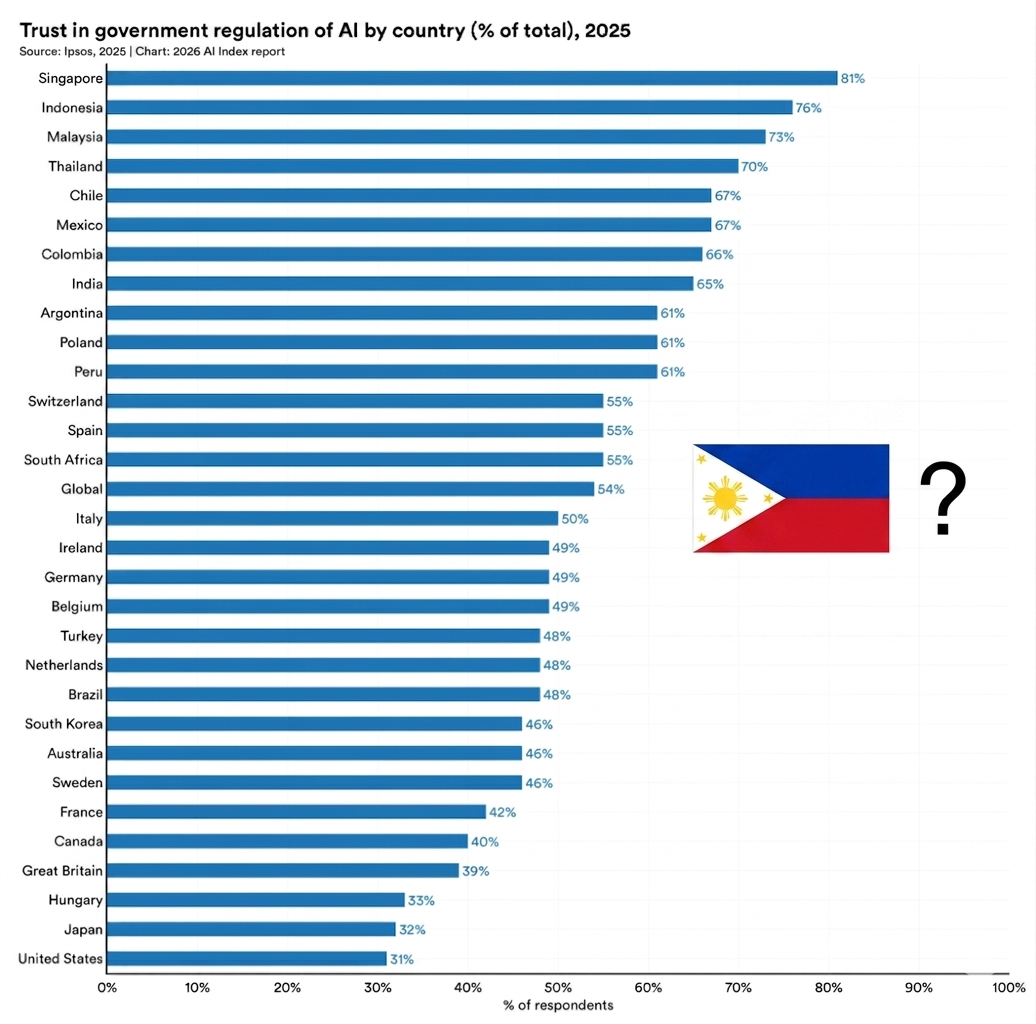
There's one thing that really bothered me. The Philippines was often EXCLUDED in surveys and in the report. We had no participation in the AI governance mechanisms (see UN's Governing AI for Humanity). Even in global trust and perspective surveys related to AI, the Philippines was invisible. We are barely mentioned in the charts. Our Asian neighbors Indonesia and Vietnam are even better positioned than us.


The only notable part where the Philippines has clear involvement was the Distribution of AI Applications by Geographic Area, Type, and Funding, but even this is limited to two specific sectors: Education and Financial Services:

That is a big problem! We are a country of early adopters. We have a massive workforce that uses these tools every day. However, when the big institutions talk about "global" trust, they often skip us.
We cannot afford to be invisible. We have to make things happen even when we have fewer resources than the US or China. We need to be part of the conversation about how AI is managed.
Related Articles
We May Be Looking for the Skills Gap in the Wrong Place
Studies and congressional reviews in the Philippines have pointed to a persistent concern: many K–12 Senior High School graduates enter tertiary education needing additional support in foundational knowledge and skills. …
Read More →AI Just Designed 16 New Viruses. Should We Be Worried?
Scientists just used artificial intelligence to design 16 new viruses! These viruses do not exist in nature. The AI invented them from scratch. You can read the latest reports from …
Read More →Solving Code-Switching ASR for Davao and Beyond
Let's face it. Communication in the Philippines has stopped being a single-language thing. If you listen to a conversation in Davao City today, you'll rarely hear pure English, pure Tagalog, …
Read More →Subscribe to Updates
Get notified about new blog posts, AI insights, and digital transformation strategies.
We respect your privacy. Unsubscribe at any time.