Cracking the Metabolic Code: How IT Professionals Can Leverage the 7% Rule to Reverse Type 2 Diabetes
Explore my NLP research and published research.
IT professionals are prone to highly sedentary work patterns. Research published in the International Journal of Medicine and Public Health notes that while many IT employees have good knowledge of diabetes, they struggle to implement preventive practices due to time constraints and fatigue [2].
- The 180-Minute Threshold: A study found that sitting for over 180 minutes per day at work is significantly associated with elevated blood glucose levels. Those who sit for long durations and have a family history of diabetes are three times more likely to develop the condition [4].
- Overwork Risks: Large-scale cohort studies have demonstrated a "dose-response" relationship between working hours and glucose intolerance. Men working more than 52 hours per week have a significantly higher hazard ratio for developing diabetes compared to those working standard 35–40 hour weeks [3].
The risk isn't just about what happens at the desk, but the "digital fatigue" that follows.
- The Computer/TV Link: According to research highlighted by the Diabetes Care Community, individuals who use a computer or watch TV for more than 40 hours per week are three times more prone to developing Type 2 Diabetes compared to those with lower screen time. This is often independent of other exercise, meaning even "active" IT workers are at risk if their screen time remains extremely high [5].
The tech industry is known for high-pressure deadlines and shift work (such as night shifts for global support).
- Shift Work Synergy: Research indicates that long working hours (over 45 hours/week) combined with shift work can increase the risk of diabetes by more than double (2.43x) [4].
- Stress as a Catalyst: Stress triggers the release of cortisol, which can increase insulin resistance. Furthermore, nearly 63% of corporate professionals in high-stress roles report sleeping 6 hours or less, a factor strongly linked to metabolic dysfunction [6].
The good news is that recent studies show that reversing type 2 diabetes is possible. The National Geographic published an article entitled "It’s possible to reverse diabetes—and even faster than you think" which highlights a shift in medical understanding: Type 2 Diabetes is increasingly being viewed as a reversible condition rather than a strictly progressive one [1]. Here are 4 key takeaways:
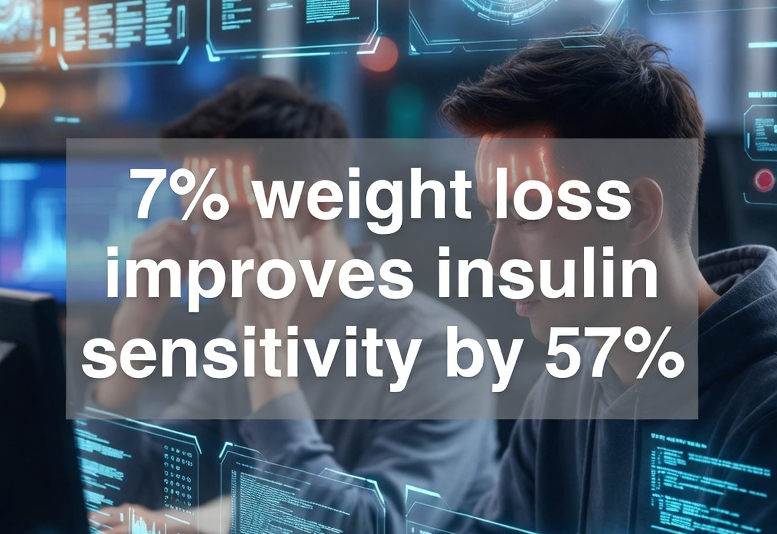
- The "7% Rule" is a Game Changer. One of the most striking statistics mentioned is that even a 7% weight loss improves insulin sensitivity by 57%. For many, "weight loss" feels like an insurmountable mountain. By quantifying it and showing that a relatively small, achievable change can yield a massive physiological return, the article provides a roadmap that is grounded in data rather than vague platitudes.
- Efficiency Through Lifestyle "Algorithms". The article doesn't just suggest "moving more"; it identifies specific variables: sleep (7–9 hours), stress reduction, and dietary fiber (that act as the "code" to fix a broken biological process). It reframes the body's metabolic system as something that can be "re-optimized" through specific inputs.
- The Power of "Personal Fat Threshold". The research by Professor Roy Taylor (mentioned in the context of these findings) introduces the idea of a Personal Fat Threshold. This explains why some people with a lower BMI still develop T2D while others do not. This is a crucial "training" point: health is not one-size-fits-all. Understanding one's own biological thresholds is key to managing health, much like understanding a system's capacity before it crashes.
- Strategic Implementation. It is like converting "academic SEO into business SEM." This article does exactly that for health. It takes the "academic" science of endocrinology and turns it into "Search Engine Marketing" for the body: direct, actionable results (remission) through targeted investment (diet and exercise).
As someone who advocates for strategic technology integration, I see a massive opportunity for the IT industry to lead the way in health-tech adoption. We can use the very tools we build to mitigate these risks:
- Workload Automation: By leveraging AI to automate repetitive administrative tasks, we can reduce the "overwork" hours that lead to glucose intolerance.
- Predictive Well-being: AI-driven work pattern monitoring can now identify early signs of burnout and "digital sedentary fatigue" before they manifest as metabolic disorders.
- The Personal Fat Threshold: Just as we monitor a server's capacity, understanding your "Personal Fat Threshold" (the point where your body can no longer safely store fat) is key to personalized prevention.
The IT industry is high-risk, but we are also the most equipped to solve the problem. By applying the logic of systems optimization to our own health, we can convert our "Academic SEO" (understanding the science) into "Business SEM" (achieving the results of a healthier, more productive life).
References
- N. Leichman, "Reversing type 2 diabetes is possible. Here's how," National Geographic, Oct. 2024. [Online]. Available: https://www.nationalgeographic.com/science/article/type-2-diabetes-reversible-diet-exercise.
- D Lalloo, J Lewsey, S V Katikireddi, E B Macdonald, E Demou, Health, lifestyle and occupational risks in Information Technology workers, Occupational Medicine, Volume 71, Issue 2, March 2021, Pages 68–74, https://doi.org/10.1093/occmed/kqaa222
- M. Kivimäki et al., "Long working hours, socioeconomic status, and the risk of incident type 2 diabetes: a meta-analysis of published and unpublished data from 222,120 individuals," The Lancet Diabetes & Endocrinology, vol. 3, no. 1, pp. 27–34, Jan. 2015. [Online]. Available: https://pmc.ncbi.nlm.nih.gov/articles/PMC4286814/.
- S. Bannai et al., "The risk of developing diabetes in association with long working hours differs by shift work schedules," Journal of Epidemiology, vol. 26, no. 7, pp. 342–349, July 2016. [Online]. Available: https://www.researchgate.net/publication/298901816.
- Jang, Dong Kee, Hyung Seok Nam, Mina Park, and Yeo Hyung Kim. 2023. "Differences in Associated Factors of Sedentary Behavior by Diabetes Mellitus Status: A Nationwide Cross-Sectional Study" Journal of Clinical Medicine 12, no. 17: 5453. https://doi.org/10.3390/jcm12175453
- Tianwei Xu, Alice J. Clark, Jaana Pentti, Reiner Rugulies, Theis Lange, Jussi Vahtera, Linda L. Magnusson Hanson, Hugo Westerlund, Mika Kivimäki, Naja H. Rod; Characteristics of Workplace Psychosocial Resources and Risk of Diabetes: A Prospective Cohort Study. Diabetes Care 5 January 2022; 45 (1): 59–66. https://doi.org/10.2337/dc20-2943
Related Articles
The "AI Prompt" Pandemic in Academic Publishing
I’ve been coming across a growing number of published journal articles and technical papers that have one thing in common: The AI's "closing suggestions" were left in the final text.From …
Read More →Compromised ISP Network? Botnet Brute Force and Compromised Infrastructure
I blocked a list of SSH brute-force attackers on my server's firewall, and the entire network lost Internet access. When I rolled back the rules, connectivity was restored. Here is …
Read More →Surviving the 2026 Energy Shock: Why AI Training is the Best "Recession-Proof" Investment
The March 2026 conflict between the US, Israel, and Iran has sent shockwaves through the global economy. As Brent crude climbs and semiconductor supply chains tighten due to military prioritization, …
Read More →Subscribe to Updates
Get notified about new blog posts, AI insights, and digital transformation strategies.
We respect your privacy. Unsubscribe at any time.